


Most founders I meet have already decided they’re raising. They haven’t run numbers on it. It’s just the shape the thing is supposed to be. Idea, deck, pre-seed, seed, and then you’re a real company.
I thought that for years too.
Then six years went by across a few companies, one that took outside money and two I paid for out of my own account, and somewhere in there the belief quietly came apart. Capital isn’t what decides whether you make it. What it decides is which kind of company you’re permitted to become, which sounds like the smaller claim and isn’t.

Nobody tells you how much the odds moved
The thing that shifted me wasn’t an argument. It was a table.
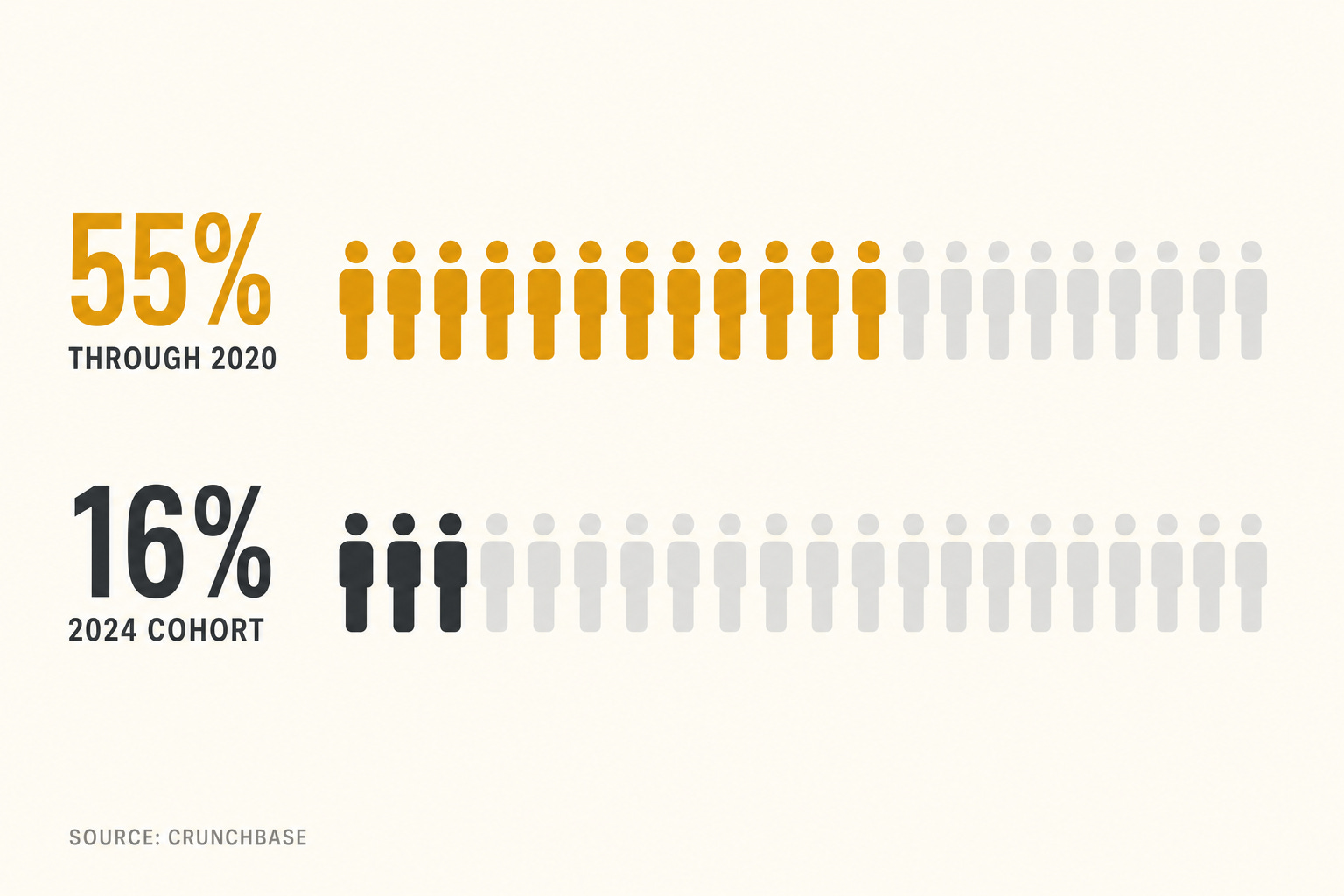
Crunchbase tracks what happens to companies after a seed round of a million dollars or more. Through 2020, a bit over half went on to something else, another round or an exit. The 2023 batch: 24%. 2024: 16%.
I stared at that for a long time and drew exactly the wrong conclusion.
Because it isn’t a death rate. It counts who took the next step on the venture path, and those are different questions. A company that turns profitable and never needs to raise again sits in the same bucket as one that ran out of money and shut the doors. In the data, both of them failed to graduate.
Which reframes the whole thing. What fell from 55% to 16% is the width of the road. Not the survival rate of the people walking it.
Look at where the money went and you can watch it narrowing. On Crunchbase’s numbers, about 80% of North American venture dollars last quarter went into AI companies. Across the first half of the year, 86% of US venture funding, and PitchBook lands in the same place. The top ten funds took 43% of all the capital in a single quarter.
Nobody got scared. They wrote record cheques. They just wrote them for a smaller and smaller kind of company.
So I stopped framing this as courage. If you don’t look like what the money is hunting for, raising isn’t bold, it’s a category error, and you’ll spend eighteen months being graded on how convincingly you impersonate a company you aren’t while your actual customers go unattended.
The one question I ask now
Name what the money buys that you can’t build, wait for, or grow into.
One sentence. Out loud.
If you can, go and raise. Some businesses genuinely cannot exist any other way, and there are more of them now than five years ago, not fewer.
Anything running heavy inference, for a start. ICONIQ’s 2026 State of AI survey puts AI-native gross margins around 52% this year, against the 75 to 85% investors are used to seeing from software, and Bessemer’s pricing work lands in the same territory at 50 to 60%. Martin Casado at a16z explains the mechanism better than I can. Software used to have a kind of gravity pulling margins up toward 70 or 80%, because once you’d built the thing, serving the next customer cost you almost nothing. Inference breaks that gravity. Every call burns compute, the cost lands in COGS, and it grows as you grow. You cannot bootstrap up a curve like that. Capital is the correct answer, and anyone telling you otherwise hasn’t looked at the bill.
Hardware. Inventory. Regulated markets. Marketplaces that need both sides full before either side finds them useful. Same story.
But if the next customer costs you close to nothing, and most software still works this way, then money isn’t buying what you’re short of. What you’re short of is evidence that anybody wants this, and that has never once been for sale.
Most founders can’t answer the question cleanly. They want the round for permission. To feel legitimate. To be able to use the word “funded” at a dinner. I’ve wanted it for every one of those reasons, which is how I recognise it, so read this as confession rather than accusation.
What actually changes once the money is in
I’ve been on that side too.
One of the companies I’ve been part of took institutional money, and the thing I hadn’t anticipated was how quickly the reporting rhythm started deciding what counted as a good week.
Nobody sits you down and instructs you. There’s no meeting about it. It’s that once an update goes out on a fixed schedule, you start, without noticing, doing the things that look like something in an update. Features shipped look like something. Headcount looks like something. Four weeks spent discovering that your central assumption was wrong looks like nothing at all, and it is routinely the most valuable month of the quarter.
That’s the cost that never makes the pitch. Not interference. Not bad investors, I’ve had good ones. Just a scoreboard that starts choosing your priorities before you’ve agreed to let it.
Five things you decide differently with nobody to report to
Skipping the freedom-and-control speech.
You’re allowed to get smaller. Three months into TinyWhale we went from five developers to two. We’d been building for an educator who lived entirely in our heads. Bootstrapped, that was a Tuesday. Funded, it’s a different conversation, because you’ve just told a room of people you’re scaling, the deck counts heads, and “we’re shrinking so we can go and listen to some customers” is not a sentence you say to a board two quarters after a raise. You can think it. Saying it is the problem.
Small numbers can be good news. Toshi, the AI calendar I build with my co-founder, has been through three versions in six months. Not three feature sets. Three different bets on what the product even is. You get roughly one of those on somebody else’s money before the goodwill thins. We’ve had three, and we’re still small and still unproven, and I’d argue that’s the point rather than the problem, though ask me again when we actually know.
The same result gets graded twice. A company that reaches a few million in revenue and gets acquired is a life-changing year for its founders and a rounding error in a fund’s model. Same customers, same revenue, opposite verdict. Venture arithmetic needs a small number of enormous outcomes to work, so anything merely good doesn’t clear the bar. That isn’t a criticism. It’s just how the maths has to behave when most of your bets go to zero. But adopt that arithmetic yourself and a lot of perfectly good endings quietly leave the table.
You end up with growth you didn’t buy. No ad budget at TinyWhale, so it grew on educators telling other educators. At Toshi we can’t outbid anyone for an install, so brands and communities host their calendars with us for free and bring their audiences along. Paid acquisition works beautifully, right until the month you stop paying for it. Not being able to buy growth pushed us toward the kind that keeps running when the money doesn’t, and it took far longer, and I resented it at the time.
You keep the choice. The one people miss. Bootstrapping isn’t the opposite of raising, it’s what turns raising into a decision rather than a dependency. Calendly took $550K in 2014, ran profitably for years, then raised $350M at a $3B valuation on its own terms. Zapier raised $1.3M in 2012, was profitable by early 2014, and reached $100M ARR without going back. Both could have stood up and walked out of any meeting they were in. That is exactly why the terms were good.
And for most of their lives, both were non-graduates in the data I opened with. Zapier. Nine figures of revenue, answering to nobody, filed under didn’t make it.
Sit with that before you quote the statistic at anyone.
What it costs, honestly
I don’t want to make this sound tidy, because it wasn’t.
You pay for bootstrapping in time and personal risk instead of equity, and the bill still arrives, just somewhere less visible. I built TinyWhale on nights and weekends while working full time at Criteo, with a toddler, a newborn, and an MBA running at the same time. It worked. It also cost my family things I still can’t put a number against, and I’d be lying if I said I’d sign up for exactly that again without a long pause first.
It’s slower, too, and that matters. If you’re in a genuine land grab, where one company takes the category and the rest evaporate, the speed money buys is worth every point of dilution. Those markets exist. I just think there are far fewer of them than there are founders who’ve persuaded themselves they’re standing in one.
And I’m not writing this from the far side of anything. TinyWhale is finished and it worked. Toshi is a live bet with a small user base and a healthy number of ways to go wrong. Ask me in two years and I might be writing the opposite piece.
Where that leaves you
Something inverted while nobody was announcing it. Raising used to be the default, and bootstrapping was the consolation prize for people nobody would fund. Now, with one in six seed companies going further and 80% of the money chasing a single category, raising is the specialised move. It needs a reason.
So say the sentence out loud, the way you’d say it to someone who intends to argue with you. Here’s what the money buys that I can’t build, wait for, or grow into.
If it comes out clean, go and raise.
If you hear yourself explaining, you already know.